The convective heat transfer coefficient, h, can be defined as:
The rate of heat transfer between a solid surface and a fluid per unit surface area per unit temperature difference.
As can be seen, the constant of proportionality will be crucial in calculations and it is known as the convective heat transfer coefficient, h. The convective heat transfer coefficient, h, can be defined as:
The rate of heat transfer between a solid surface and a fluid per unit surface area per unit temperature difference.
The convective heat transfer coefficient is dependent upon the physical properties of the fluid and the physical situation. The convective heat transfer coefficient is not a property of the fluid. It is an experimentally determined parameter whose value depends on all the variables influencing convection such as the surface geometry, the nature of fluid motion, the properties of the fluid, and the bulk fluid velocity.
Typically, the convective heat transfer coefficient for laminar flow is relatively low compared to the convective heat transfer coefficient for turbulent flow. This is due to turbulent flow having a thinner stagnant fluid film layer on the heat transfer surface.
It must be noted, this stagnant fluid film layer plays crucial role for the convective heat transfer coefficient. It is observed, that the fluid comes to a complete stop at the surface and assumes a zero velocity relative to the surface. This phenomenon is known as the no-slip condition and therefore, at the surface, energy flow occurs purely by conduction. But in the next layers both conduction and diffusion-mass movement in the molecular level or macroscopic level occurs. Due to the mass movement the rate of energy transfer is higher. As was written, nucleate boiling at the surface effectively disrupts this stagnant layer and therefore nucleate boiling significantly increases the ability of a surface to transfer thermal energy to bulk fluid.
A similar phenomenon occurs for the temperature. It is observed, that the fluid’s temperature at the surface and the surface will have the same temperature at the point of contact. This phenomenon is known as the no-temperature-jump condition and it is very important for theory of nucleate boiling.
Values of the heat transfer coefficient, h, have been measured and tabulated for the commonly encountered fluids and flow situations occurring during heat transfer by convection.
Example: Convection heat transfer coefficient values
In the analysis of internal and external flows, the convection heat transfer coefficient, , is typically used to express with the relevant temperature variation, , the heat flux density. In the analysis of seepage flows, the separate terms are used to equivalently express the convection heat transfer coefficient. Accordingly, the convection heat transfer coefficient depends on (1) the fluid thermophysical properties and (2) the fluid velocity. These factors should be considered in the analysis and design of energy geostructures.
en: Coeficiente de transferencia de calor por convección
Critical Reynold’s number.
Noun
The critical Reynolds number is associated with the laminar-turbulent transition, in which a laminar flow becomes turbulent.
For flow in a pipe of diameter D, experimental observations show that for “fully developed” flow, the critical Reynolds number is about Red,crit = 2300.
For flow over a flat plate, transition from laminar to turbulent boundary layer occurs when Reynolds number at x exceeds Rex,crit ~ 500,000.
The Reynolds number is the ratio of inertial forces to viscous forces and is a convenient parameter for predicting if a flow condition will be laminar or turbulent.
The critical Reynolds number is associated with the laminar-turbulent transition, in which a laminar flow becomes turbulent. This is an extraordinarily complicated process, which at present is not fully understood.
The value of the critical Reynolds number is different for different geometries.
For flow over a flat plate, the generally accepted value of the critical Reynolds number is Rex ~ 500000.
For flow in a pipe of diameter D, experimental observations show that for “fully developed” flow, laminar flow occurs when ReD < 2300 and turbulent flow occurs when ReD > 3500.
For a sphere in a fluid, the characteristic length-scale is the diameter of the sphere and the characteristic velocity is that of the sphere relative to the fluid. Purely laminar flow only exists up to Re = 10 under this definition.
Example: In determining whether the boundary layer is laminar or turbulent, it is frequently reasonable to assume that transition begins at some location xcrit, as shown in figure. This location is determined by the critical Reynolds number, Rex,crit. For flow over a flat plate,
en: Número crítico de Reynolds.
Friction Coefficient
Noun
The coefficient of friction (COF), often symbolized by the Greek letter µ, is a dimensionless scalar value which equals the ratio of the force of friction between two bodies and the force pressing them together, either during or at the onset of slipping. The coefficient of friction depends on the materials used; for example, ice on steel has a low coefficient of friction, while rubber on pavement has a high coefficient of friction. Coefficients of friction range from near zero to greater than one. It is an axiom of the nature of friction between metal surfaces that it is greater between two surfaces of similar metals than between two surfaces of different metals— hence, brass will have a higher coefficient of friction when moved against brass, but less if moved against steel or aluminum.
Arthur Morin introduced the term and demonstrated the utility of the coefficient of friction. The coefficient of friction is an empirical measurement – it has to be measured experimentally, and cannot be found through calculations. Rougher surfaces tend to have higher effective values. Both static and kinetic coefficients of friction depend on the pair of surfaces in contact; for a given pair of surfaces, the coefficient of static friction is usually larger than that of kinetic friction; in some sets the two coefficients are equal, such as teflon-on-teflon.
Most dry materials in combination have friction coefficient values between 0.3 and 0.6. Values outside this range are rarer, but teflon, for example, can have a coefficient as low as 0.04. A value of zero would mean no friction at all, an elusive property. Rubber in contact with other surfaces can yield friction coefficients from 1 to 2. Occasionally it is maintained that μ is always < 1, but this is not true. While in most relevant applications μ < 1, a value above 1 merely implies that the force required to slide an object along the surface is greater than the normal force of the surface on the object. For example, silicone rubber or acrylic rubber-coated surfaces have a coefficient of friction that can be substantially larger than 1.
While it is often stated that the COF is a "material property," it is better categorized as a "system property." Unlike true material properties (such as conductivity, dielectric constant, yield strength), the COF for any two materials depends on system variables like temperature, velocity, atmosphere and also what are now popularly described as aging and deaging times; as well as on geometric properties of the interface between the materials, namely surface structure.[1] For example, a copper pin sliding against a thick copper plate can have a COF that varies from 0.6 at low speeds (metal sliding against metal) to below 0.2 at high speeds when the copper surface begins to melt due to frictional heating. The latter speed, of course, does not determine the COF uniquely; if the pin diameter is increased so that the frictional heating is removed rapidly, the temperature drops, the pin remains solid and the COF rises to that of a 'low speed' test.
Example: As of 2012, a single study has demonstrated the potential for an effectively negative coefficient of friction in the low-load regime, meaning that a decrease in normal force leads to an increase in friction. This contradicts everyday experience in which an increase in normal force leads to an increase in friction.
en: Coeficiente de fricción
Kinematic viscosity
Noun
In fluid dynamics, it is sometimes more convenient to work in terms of the kinematic viscosity (sometimes also called the momentum diffusivity), defined as the ratio of the viscosity μ to the density of the fluid ρ. It is usually denoted by the Greek letter nu (ν) and has dimension (length)^2/time:
FIGURE 1
in order to distinguish it from the dynamic viscosity u , which has dimension (mass/lenght)/time
Example: One of the most common instruments for measuring kinematic viscosity is the glass capillary viscometer.
en: Viscosidad cinemática
Laminar flow
Noun
In fluid dynamics, laminar flow is characterized by fluid particles following smooth paths in layers, with each layer moving smoothly past the adjacent layers with little or no mixing. At low velocities, the fluid tends to flow without lateral mixing, and adjacent layers slide past one another like playing cards. There are no cross-currents perpendicular to the direction of flow, nor eddies or swirls of fluids. In laminar flow, the motion of the particles of the fluid is very orderly with particles close to a solid surface moving in straight lines parallel to that surface. Laminar flow is a flow regime characterized by high momentum diffusion and low momentum convection.
When a fluid is flowing through a closed channel such as a pipe or between two flat plates, either of two types of flow may occur depending on the velocity and viscosity of the fluid: laminar flow or turbulent flow. Laminar flow occurs at lower velocities, below a threshold at which the flow becomes turbulent. The velocity is determined by a dimensionless parameter characterizing the flow called the Reynolds number, which also depends on the viscosity and density of the fluid and dimensions of the channel. Turbulent flow is a less orderly flow regime that is characterized by eddies or small packets of fluid particles, which result in lateral mixing. In non-scientific terms, laminar flow is smooth, while turbulent flow is rough.
Example: Laminar flow generally occurs when the fluid is moving slowly or the fluid is very viscous. As the Reynolds number increases, such as by increasing the flow rate of the fluid, the flow will transition from laminar to turbulent flow at a specific range of Reynolds numbers, the laminar–turbulent transition range depending on small disturbance levels in the fluid or imperfections in the flow system. If the Reynolds number is very small, much less than 1, then the fluid will exhibit Stokes, or creeping, flow, where the viscous forces of the fluid dominate the inertial forces.
en: Flujo laminar
Nusselt number
Can be a verb, an adjective or a noun.
In fluid dynamics, the Nusselt number (Nu) is the ratio of convective to conductive heat transfer at a boundary in a fluid. Convection includes both advection (fluid motion) and diffusion (conduction). The conductive component is measured under the same conditions as the convective but for a hypothetically motionless fluid. It is a dimensionless number, closely related to the fluid's Rayleigh number.
A Nusselt number of value one represents heat transfer by pure conduction. A value between one and 10 is characteristic of slug flow or laminar flow. A larger Nusselt number corresponds to more active convection, with turbulent flow typically in the 100–1000 range. The Nusselt number is named after Wilhelm Nusselt, who made significant contributions to the science of convective heat transfer.
A similar non-dimensional property is the Biot number, which concerns thermal conductivity for a solid body rather than a fluid. The mass transfer analogue of the Nusselt number is the Sherwood number,
Example: The Nusselt number is the ratio of convective to conductive heat transfer across a boundary. The convection and conduction heat flows are parallel to each other and to the surface normal of the boundary surface, and are all perpendicular to the mean fluid flow in the simple case.
en: Número de Nusselt
Prandtl number
Can be a verb, an adjective or a noun.
The Prandtl number (Pr) is a dimensionless number proportional to the quotient between the diffusion rate of the amount of moment (viscosity) and the thermal diffusivity.
It is named after the German engineer and physicist Ludwig Prandtl.
In mercury, heat conduction is very effective compared to speed, or the ability to transmit moment, therefore the Prandtl number is low as in other liquid metals. On the other hand, for motor oil, convection is very efficient transferring heat compared to conduction, therefore the Prandtl number is high.
In the table on the right, which shows values of the Prandtl number for different materials, it can be seen that liquid metals have very low Prandtl numbers, gases have the particularity of having a Prandtl number around 0.70 , water has an intermediate value, and finally the highest values of the Prandtl number are presented by viscous fluids.
In general, for non-metallic or oily gases and liquids, the order of magnitude of the Prandtl number is unity, and its magnitude varies very little with temperature or pressure.
In heat transfer problems the Prandtl number controls the relative thickness of the moment and thermal boundary layers. When Pr is small it means that the heat diffuses very fast compared to the velocity (moment).
The dimensionless number analogous in mass transfer to the Prandtl number is the Schmidt number.
Example: For air with a pressure of 1 bar, the Prandtl numbers in the temperature range between -100 °C and +500 °C can be calculated using the formula given below.[2] The temperature is to be used in the unit degree Celsius. The deviations are a maximum of 0.1 % from the literature values.
en: Número de Prandtl
Reynolds number
Can be a verb, an adjective or a noun.
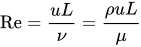
The Reynolds number (Re) helps predict flow patterns in different fluid flow situations. At low Reynolds numbers, flows tend to be dominated by laminar (sheet-like) flow, while at high Reynolds numbers flows tend to be turbulent. The turbulence results from differences in the fluid's speed and direction, which may sometimes intersect or even move counter to the overall direction of the flow (eddy currents). These eddy currents begin to churn the flow, using up energy in the process, which for liquids increases the chances of cavitation. Reynolds numbers are an important dimensionless quantity in fluid mechanics.
The Reynolds number has wide applications, ranging from liquid flow in a pipe to the passage of air over an aircraft wing. It is used to predict the transition from laminar to turbulent flow, and is used in the scaling of similar but different-sized flow situations, such as between an aircraft model in a wind tunnel and the full size version. The predictions of the onset of turbulence and the ability to calculate scaling effects can be used to help predict fluid behaviour on a larger scale, such as in local or global air or water movement and thereby the associated meteorological and climatological effects.
The concept was introduced by George Stokes in 1851, but the Reynolds number was named by Arnold Sommerfeld in 1908 after Osborne Reynolds (1842–1912), who popularized its use in 1883.
Example: The Reynolds number is the ratio of inertial forces to viscous forces within a fluid which is subjected to relative internal movement due to different fluid velocities. A region where these forces change behavior is known as a boundary layer, such as the bounding surface in the interior of a pipe. A similar effect is created by the introduction of a stream of high-velocity fluid into a low-velocity fluid, such as the hot gases emitted from a flame in air.
en: Número de Reynolds
Shear stress
Noun
Shear stress, force tending to cause deformation of a material by slippage along a plane or planes parallel to the imposed stress. The resultant shear is of great importance in nature, being intimately related to the downslope movement of earth materials and to earthquakes. Shear stress may occur in solids or liquids; in the latter it is related to fluid viscosity.
Shear stress, often denoted by τ (Greek: tau), is the component of stress coplanar with a material cross section. It arises from the shear force, the component of force vector parallel to the material cross section. Normal stress, on the other hand, arises from the force vector component perpendicular to the material cross section on which it acts.
Example: The formula to calculate average shear stress is force per unit area.
en: Esfuerzo cortante
Turbulent flow
Noun
Turbulent flow, type of fluid (gas or liquid) flow in which the fluid undergoes irregular fluctuations, or mixing, in contrast to laminar flow, in which the fluid moves in smooth paths or layers. In turbulent flow the speed of the fluid at a point is continuously undergoing changes in both magnitude and direction. The flow of wind and rivers is generally turbulent in this sense, even if the currents are gentle. The air or water swirls and eddies while its overall bulk moves along a specific direction.
Most kinds of fluid flow are turbulent, except for laminar flow at the leading edge of solids moving relative to fluids or extremely close to solid surfaces, such as the inside wall of a pipe, or in cases of fluids of high viscosity (relatively great sluggishness) flowing slowly through small channels. Common examples of turbulent flow are blood flow in arteries, oil transport in pipelines, lava flow, atmosphere and ocean currents, the flow through pumps and turbines, and the flow in boat wakes and around aircraft-wing tips.
Example: Turbulent flow is a type of fluid (gas or liquid) flow in which the fluid undergoes irregular fluctuations, or mixing, in contrast to laminar flow, in which the fluid moves in smooth paths or layers. In turbulent flow the speed of the fluid at a point is continuously undergoing changes in both magnitude and direction. The flow of wind and rivers is generally turbulent in this sense, even if the currents are gentle. The air or water swirls and eddies while its overall bulk moves along a specific direction.
Most kinds of fluid flow are turbulent, except for laminar flow at the leading edge of solids moving relative to fluids or extremely close to solid surfaces, such as the inside wall of a pipe, or in cases of fluids of high viscosity (relatively great sluggishness) flowing slowly through small channels. Common examples of turbulent flow are blood flow in arteries, oil transport in pipelines, lava flow, atmosphere and ocean currents, the flow through pumps and turbines, and the flow in boat wakes and around aircraft-wing tips.